Showing posts with label Psalmopoeus. Show all posts

Tuesday, August 11, 2015

#55 - PHOTOGRAPHY

At the Minnverts gathering this past weekend I was with two serious and skilled photographers: Chad Campbell and Michael Pankratz. As many of you know, Chad is a moderator on Arachnoboards and is better known there as "advan". He mentioned that he had been spending some time improving on the photography subforum there. Since I no longer am on FriendFace, FaceBlock, Faffbook, Fuckbook or Fussbook, I no longer have that outlet for easily sharing images and may resume my "New Michael Jacobi Photo Thread" on AB. However, these are, and will be, watermarked 72 dpi compressed images. I just wanted to remind you that my real galleries, where you can view high resolution images (still at screen resolution though) without watermark, is at exoticfauna.smugmug.com. Please bookmark and revisit every now and again. These are my complete galleries and you can even order prints.

I'd love to share some info on photography skills and possibly turn that into another ongoing series, but here I just wanted to post a few images of spiders that I am packing for customers today and make a few comments on spider portraits and photography in general.

First, for the gear heads, in an earlier blog entry (#12A - PART ONE: SUNDAY, FUN DAY) I mentioned some of the arachnocultural products I use and where to get them cheap. It was just a listing of things I recommend without any endorsement or free product in return. I closed that installment with my camera rig details and I will copy and paste that here.

Camera Rig: The majority of the photos you see me post are taken with a Nikon D7100 body and a Tokina 100mm 1:1 2.8 macro lens. 90% of the images are shot in aperture priority mode at f18 and ISO100 and usually 1/60 sec. Sometimes I go fully manual if I want to select shutter speed a bit, say to 1/125 sec or maybe adjust ISO to 200 or 400. Smaller subjects are usually lit with a Sigma EM-140 ring flash, while larger spiders are lit with a PocketBox Mini Softbox on a SB900 speedlight in the hot shoe. I often use TTL, but may set ring flash to TTL BL or manually reduce output on SB900 or use only one side of the ring flash in certain situations. I never, ever, ever use the camera's built-in mini speedlight. They are taped down! For photography other than spider and herp portraits I use Nikkor's 17-55mm 2.8, 35mm 1.8 and 18-200 VR 5.6. For human portraits I light subject with a Gary Fong Lightsphere mounted on the SB-900 or a SB-600. When in the field if I need to have two set-ups at the ready I use my old Nikon D90 body with the macro lens and flash and use the D7100 with the 17-55 or 18-200.

I shoot both RAW and Fine JPEG, but normally use the RAW file imported into Adobe Lightroom 6/CC on a MacBook Pro for processing. Photoshop CC is used for background removal or to remove unwanted dirt or something from the image. I export my finished images as TIF to an external hard drive and Fine JPEG (6000 x 4000 pixels) to my internal hard drive (these go to SmugMug) and make a 1280 pixel wide watermarked and branded version using both Lightroom and Adobe Fireworks for posting on social media. My full resolution photo galleries are at exoticfauna.smugmug.com where you can order prints.

The important detail above is that I "never, ever, ever use the camera's built-in mini speed light". If you are shooting with a decent DSLR get your flash above or off the camera body. Use soft boxes on speed lights on brackets, arms or held on a sync cord or mounted on a tripod. I will go into further detail in future blogs. However, your built-in flash gives direct, unnatural and unflattering light. You can have some reasonable results and I know at least one photographer who posts tons of decent tarantula pix using this on camera flash. But a trained eye can pick out the poor lighting and the resultant problems with shadows and highlights. Some of these could be corrected in post-production when shooting RAW, but it is best to capture the best data first.

I used to use my ring flash for everything, but it broke a few months ago thanks to my clumsiness and while waiting for it to be repaired I began using my tall SB900 speed light with the Pocketbook Mini Softbox. I normally use this set-up for snakes and lizards and larger creatures on field trips, but it is now my go to method for adult tarantulas and all the pix below were taken with a Nikon D7100 with a SB900 flash on TTL or TTL BL with the softbox. I use the ring flash for small subjects only now. All of the below photos were taken handheld at f/18 at 1/60 sec. Lightroom was used to process the RAW files and add some clarity, adjust white balance and add a bit of vignetting.

Now that I've talked about gear, let's forget all about expensive toys. Yes, if you want to get serious about photography, and especially macrophotography, you need to get at least a midrange DSLR and a bunch of money-sucking add ons. The Tokina 100mm 1:1 macro lens is the best bang for your buck and you'll need lighting other than what your camera possesses. However, to turn a snapshot into a photograph is all about COMPOSITION, COMPOSITION, COMPOSITION. If you are limited to a point and shoot or even a camera phone you needn't worry about f-stops and focal length and such. You should concentrate on composition and making the best use of available light. Google the rule of thirds and other compositional rules. You can break these later, but master them first. Even if you are just taking a selfie for Instagram think about composition. Take sunglasses off (always!), use the rule of thirds, avoid harsh midday light and shadows, try different angles, get artsy. Think about background. Turn your snapshot into a photograph.

Again, all of these photos were taken this morning and all of these spiders were packed to ship to new homes. For many more images of arachnids, reptiles and other creatures, both in nature and the terrarium and without watermarks, please visit my Smugmug. Enjoy, MJ

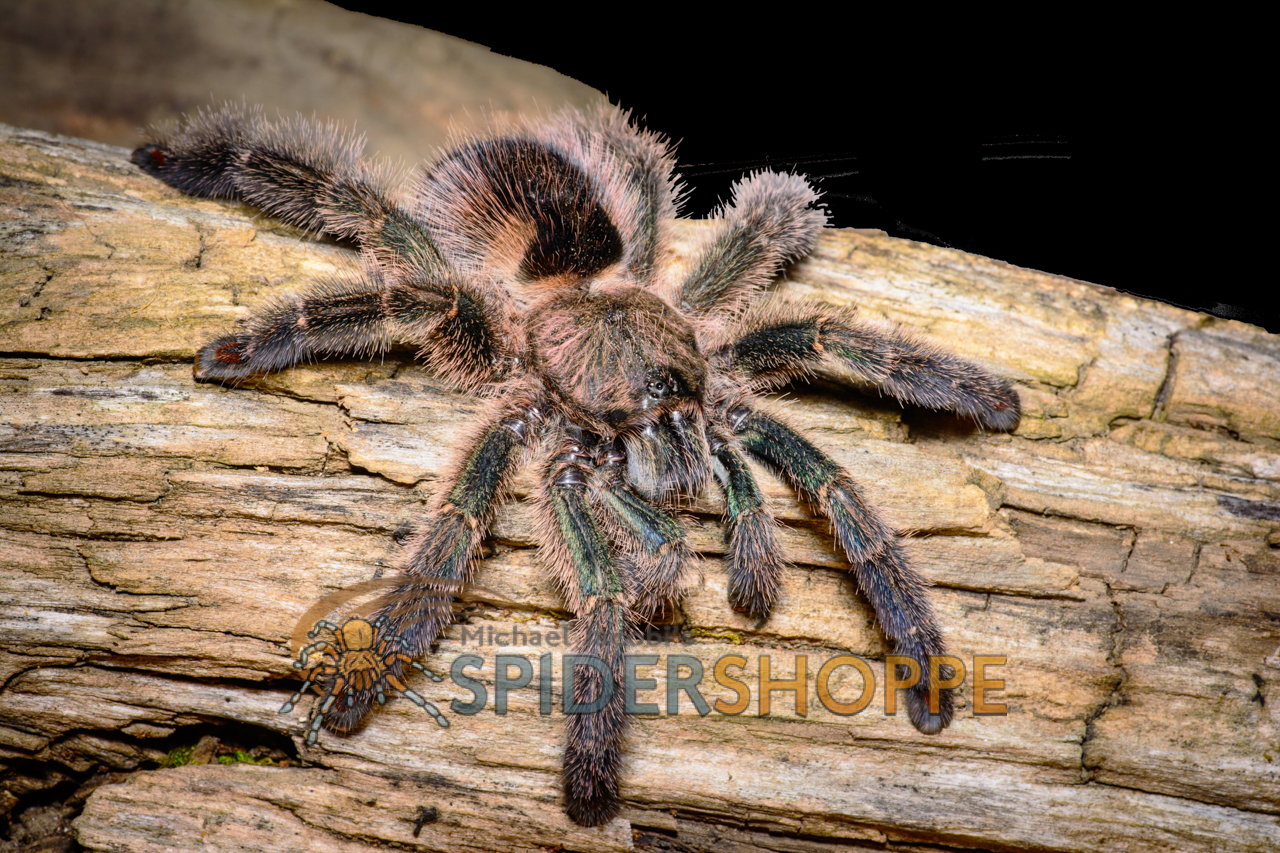
Psalmopoeus cambridgei x irminia
This spider was offered free and shipped to A.W. with the restriction that it never be bred or sold.

Psalmopoeus cambridgei on its way to A.W.'s mom.
Compare this spider to the hybrid above.

This adult female Iridopelma hirsutum 'Recife' is also on its way to A.W.

T.R. is receiving this adult female Avicularia diversipes
This female Lampropelma nigerrimum headed to T.R. was a complete bitch!
This is the best photo I could capture and you'll notice her spread "jaws" and raised legs.
She alternated between threat posture and biting my forceps to doing the drop and roll.
I'm sure some of you are familiar with how these spiders will just roll into a ball and drop off the wood.
In fact, T.R. is also getting a Lampropelma sp. Borneo, but I couldn't even get her to pose for one second.
Many Ornithoctoninae are stubborn models and I lose my patience quickly.
This adult female Avicularia minatrix on her way to T.R. was much more cooperative.
At first, that is.
Unfortunately, I clipped Leg II left in the photo and after the exposure she ran into a crevice in the driftwood.
I had to break my long-used photo background wood in half to get her out.
Now, I need a new piece.
I was starting to question why I was making packing harder by shooting these photos!
D.D. is receiving this beautiful subadult female Avicularia sp. Peru tomorrow.
I had to prop up half of my now split in two driftwood background.
D.D. got some other Avics too, but most were young specimens and I had had enough camera for the day.

Sunday, July 5, 2015

#32 - TALES FROM THE FIELD #3

In my last installment of my ongoing "TALES FROM THE FIELD" series we were in Suriname. I told stories about a somewhat bizarre visit to a native Maroon village, our open air viewings of Game of Thrones and more. The first installment shared stories from Costa Rica with ice axes in my feet, cat-chased green iguanas and rear-fanged snakes held for photos by Brit mates who had no clue of their venomous bite until afterward. I'd like to add a few more glimpses into each of these field trips here.

The ice axe was certainly my first "what the fuck" moment in Costa Rica, but I learned that it was the perfect tool for the job and I highly recommend it for digging out embankment burrows. But it remained a source of amusement six years later in the jungles of Suriname. We had arrived for one of several daily visits to Brownsberg Natuurpark in search of Theraphosa blondi. Andrew was ALWAYS the last person ready each morning and usually just when we thought he would finally climb into the car he'd have to take a last minute latrine trip or retrieve one last piece of gear. Paul, Guy and I were already dressed for the jungle, but Andrew liked to ride to the site (it was a 30 minute drive to Brownsberg and then a tortuous drive uphill on a rutted and dangerous clay road) in comfy clothes. He'd wear shorts and sandals and then change once we stopped for our first hike into the dense rainforest. So there he was in the middle of the red clay road on the ascent to the top of Brownberg stripped down to his whitey-tighties. It was a moment I couldn't resist. Here was a grey and pasty white famous arachnohistorian naked except for his skivvies. I grabbed my camera and asked him to pose with his ice axe. To his credit he was very willing, as long as I promised that I would never share the image with anyone. Sorry, but I keep my promises and that picture is safe with me. But if I ever need a good laugh I have that image on my hard drive. A man I revered for many years and then became one of my best friends; a man who is famous the world over as a tarantula expert; a man who has cultivated an image as an eccentric Victorian-in-the-modern-age arachnohistorian, standing with only his nob and bollocks covered holding the ice axe in a menacing pose. He knows never to piss me off or that photo will become a viral Internet meme!

Costa Rica was the country I fell most in love with. I still dream of retiring there. It was my first field trip with Andrew and our team and I cherish all my memories of that expedition. One story that will always be remembered is my encounter with a Centruroides limbatus scorpion. Our lodging was at Capazuri outside of CaƱas in central Costa Rica. It was our 3rd base camp out of 4. We discovered that this area and many others within a short drive were teeming with Aphonopelma seemanni. It almost seemed too easy. All we had to do was take a stroll down the dirt road in back of the hotel and there was burrow after burrow holding adult female A. seemanni. This was dry country and the trees along the road held black spiny-tailed iguanas (Ctenosaura similis). Whenever you'd approach or try to photograph they would wedge themselves into the knotted branches and tree holes. We also found scorpions and another species of tarantula (presumably a Crypsidromus sp.). While we stayed at Capazuri we would locate burrows by day and then to return at night to photograph the resident tarantulas. It was great fun walking down the road and shining our flashlights ("torches" to my mates) on the dry dirt embankment and seeing all of the striped legs at the burrow mouths. The seemanni were tremendously abundant. Paul had taken to catching katydids during the day and tying string to them to sort of "fish" for the tarantulas and offer them a meal.

We always use two-way radios as our normal practice is to split into two two-man teams and spread out our search. This night I was teamed with Andrew, who was well-known for breaking protocol and wandering off alone. To be fair, I liked to do the same. So while Paul and Mark (brothers) went off somewhere out of sight it wasn't long until Andy and I lost sight of each other. Fortunately Andy was the one who carried the radio. Eventually Paul and Mark walked back my direction and the three of us "played" with all of the exposed female A. seemanni. We would catch various katydids and crickets and grasshoppers and chuck meals to the girls. I was kneeling along the roadside embankment photographing one spider when I saw a very large scorpion hastily moving alongside the bank. I had brought a camcorder to Costa Rica and I filmed the scorpion moving about the roadside. I wanted to get still shots of it the next morning so I decided I would capture it. But as I've "tailed" thousands of scorpions throughout my career, I neglected to get out my forceps and capture it safely. I reached for it's telson and before long it felt like someone had slammed my thumb in a car door. I was tagged by a hot scorpion and the pain was initially pretty intense. I clearly remember stating the obvious, "Well, that was stupid."

I must interject here to say that those of you who know me are aware that I am heavily tattooed. I wasn't then, but my arms and legs are covered now. I am famous by both of my tattoo artists for being "a rock" who can sit for 8 hours without flinching. I enjoy being tattooed. My pain tolerance is very high and I can even nap while getting tattooed. But this sting hurt! My thumb began to swell and my mates started to worry. I knew well that the best thing to do when envenomed by snake, scorpion or whatever is to remain calm. A racing heart only expedites the effects. We radioed Andy and he found his way back. He insisted on walking me back to our shared room, which was a good thing as I had become disoriented and my hand felt like it was on fire. Back at the room I reached into my kit for antihistamines and painkillers. I took about 4 times as many Benadryl as is advised and downed at least four Tylenol as well. I laid on my back on my bunk and held my arm dangling off the side towards the floor, keeping my hand well below my heart. I was sure I would be fine, but my mates were more worried. I actually dozed off and they kept checking on me during the night to see that I was OK. The pain had subsided and it was becoming more swollen and itchy than anything. Eventually I slept until morning and by then the effects had mostly dissipated. There was still a bit of swelling and the sting site was itchy. A few more Benadryl and it was on to another day. This was the last time I didn't use my forceps for Buthidae scorpion catching on a field trip. We found some beautiful Tityus paraensis in Suriname years later, which are not only hotter than the C. limbatus, but larger and more beautiful. I kept my body well away from their stingers.

Returning to Suriname ... I coined the term "Arachnohistorian" to describe Andrew Smith. He initially trained as a history teacher before studying science and his works center around the early collectors and arachnologist. He always takes us to historical sites on our field trips and we always bemoan the diversion from tarantula hunting. Our Suriname field trip was based on Madame Maria Sibylla Merian's famous trip there and her paintings of the "bird eating spider" that gave rise to the name Avicularia. Andrew wanted to visit the oldest cemetery in search of a tombstone of one of her relatives or something. I'm not much on history and don't pay much attention. We just are left with no choice but to humor him and spend a day out of the field. In fact, when we arrived at the cemetery I was happy to let him wander about while I stood on the street and walked the neighborhood looking at shops and people and buying a cool drink. The cemetery was in the capitol city of Paramaribo where over half of all Suriname's population resides. It was surrounded by a six foot brick wall and I stood alongside the wall smoking a cigar. I soon realized that the poorly kept cemetery, which was overgrown with weeds had another use. I watched men who appeared homeless climb over the wall and squat behind tombstones to defecate. My displeasure at spending a day doing this instead of chasing spiders, frogs and lizards began to increase exponentially. I warned Andrew to watch his step and to be on alert for the small brown men that were "dropping trou" among the dead. Sometimes our trip moments are surreal.

I'll conclude this entry with a return to 2006 and Costa Rica. As an arboreal specialist, the spider I most wanted to see was Psalmopoeus reduncus. But locating arboreal species can be very hard work and we had already found Tapinauchenius plumipes and Avicularia sp. I knew that the "Psalms" would be tougher and they were widespread throughout the country. So, we decided that we would not focus on them, but just hope we stumbled on to one as we searched for ground-dwelling species. Mark Carpenter is Paul's half-brother who is his junior by about a dozen years. He is not a spider man. He travels with us just to see the world and spend time with his brother in exotic locales. But he has an astonishing and very annoying habit of finding spiders before us "real spider men" on many occasions. We were in an affluent suburb near where we expected to find Cyclosternum sp. As it turned out we never located any "tiger-rumps" on our trip, and it was the only disappointment of a wonderful expedition. After spending a good deal of time in rural areas away from anything other than sparse villages with little shacks or houses, it was a bit strange to be walking past manicured lawns and some nice modern houses. But this was the type locality for our target and that afternoon we walked past saying "hola" and "buenas tardes" to Costa Rica's "upper class". It was balmy and a bit off-putting to be trespassing on the neighborhood. Mark paused at a knotted tree on the other side of a roadside fence and then asked "Michael, is this Psalmopoeus you are looking for a bronze spider that lives in trees?" This is just one of several similar occasions like this on the trip. Mark had found the spider despite not really knowing what he was looking for. He just liked to shine his "torch" into tree holes and the like and he had discovered the spider I had most wanted to see! We were able to capture it and get photographs before releasing it later.

Of course, the Costa Rican tarantula that was at the top of the entire team's wish list was Megaphobema mesomelas. This is a cloud forest spider and is most often associated with Monteverde. However, this is a national park and we try to avoid them. We don't collect, but we still have to dig out many burrowers and this would land us in trouble inside Monteverde. So we found a high elevation location east of Monteverde and took a scenic drive uphill. Costa Rica has little stands that sell cold drinks, beer and snacks or even lunch. These oases are called sodas. We came upon one that was surrounded by the fog and had a spectacular view of verdant mountains across a valley enveloped by mist and fog. We stopped for a refreshment and next to the soda was a long and steep grassy embankment. We would find many M. mesomelas here in just one quarter mile stretch of road. While the guys had wandered off to search the embankment I had myself a cold drink and spoke to the owner. I explained that we were searching for spiders using my best Spanish. He spoke a bit of English as well. Before long some young workers returned with a plastic jug containing a spider. It was a beautiful adult female orange wandering spider (Cupiennius coccineus). I explained that these were mostly harmless to humans and didn't bother challenging my Spanish ability with explaining that their venom was very deadly to arthropod prey. I took the spider out and held it for photographs. Meanwhile, the lads had found burrows holding M. mesomelas, but had yet to successfully "tickle one out" and did not want to start digging right next to the soda. The owner of the soda disappeared for ten minutes or so and when he returned he had a small cardboard box in his hands. He gave it to me and I opened it to see one of the most beautiful spiders I've ever laid eyes on in the field. It was a stunning, freshly molted female M. mesomelas. I thanked him and ran to where the guys were working burrows to show them the prize. We returned to the soda and the owner showed Andrew where he had dug up the spider for us. He knew it lived there and it was just behind the soda near his storage area. We wanted to give the guy a tip, but he refused. So we ordered a round of celebratory cold beers and some snacks from him before returning to the embankment to tickle out a few more.

I suppose I should remind you here that my entire Costa Rica story, which was originally published as the only article in the final ARACHNOCULTURE magazine, is on my website. If you want to read the story of the entire trip with images click here for the first of 30 webpages that contain the article and select the "Next Page" link to progress through the pages.

Hope your fourth was safe. Thanks for reading! MJ